Mindful Dating Red Flag Checklist (Printable Boundaries Tool)

Mindful Dating Red-Flag Checklist: A Printable Tool for Emotional Safety and Clear Boundaries
Mindful dating is less about perfection and more about paying attention—especially to patterns that affect emotional safety, respect, and consent. A simple checklist can help separate a one-off awkward moment from recurring behaviors that signal boundary-pushing, manipulation, or instability. Use a printable checklist as a grounding prompt before and after dates to stay connected to what feels safe, steady, and aligned.
What “mindful dating” looks like in real life
Mindfulness in dating isn’t a vibe—it’s a practice of staying connected to your own signals while you get to know someone. That means you’re not only assessing whether you like them, but also whether the dynamic supports your well-being.
- Notice body signals (tight chest, numbness, rushing, confusion) as information rather than something to override.
- Track patterns over time: consistency, accountability, and respect for pacing matter more than a single “perfect” date.
- Separate chemistry from compatibility: attraction can coexist with poor boundaries.
- Check in with core needs (safety, honesty, autonomy, mutual effort) before investing more deeply.
- Give yourself permission to pause, slow down, or end contact without over-explaining.
If you tend to rationalize red flags away, writing things down can keep you anchored in reality instead of momentum.
Red flags to watch for early (and why they matter)
Early dating is full of unknowns, so the goal isn’t to label someone as “good” or “bad.” The goal is to notice whether their behavior supports consent, respect, and stability. When a pattern shows up, you can respond before you feel trapped or emotionally depleted.
- Boundary testing: pushing for faster intimacy, ignoring a “no,” or repeatedly negotiating your limits.
- Love bombing: intense praise, big promises, or exclusivity pressure before genuine trust is built.
- Inconsistency: hot-and-cold contact, frequent cancellations, or vague plans that keep you waiting.
- Control cues: jealousy framed as “caring,” monitoring your time, or criticizing your friends/family.
- Blame shifting: refusing accountability, turning concerns back on you, or claiming everyone else is the problem.
- Isolation moves: discouraging outside support, creating drama around your relationships, or guilt for spending time alone.
- Anger and contempt: mocking, sarcasm during conflict, threats to leave to win arguments, or intimidating reactions.
Quick guide to early signals
| Signal type | What it can look like | What to do next |
|---|---|---|
| Red flag | Pressures for intimacy, ignores boundaries, uses guilt | Pause contact; restate boundary once; step away if repeated |
| Yellow flag | Inconsistent texting, mild defensiveness, unclear intentions | Ask a direct question; watch for follow-through |
| Green flag | Respects pacing, communicates clearly, takes accountability | Proceed slowly; keep checking alignment over time |
For deeper education on unhealthy patterns and warning signs, visit the National Domestic Violence Hotline warning signs guide. For what healthy relationship behavior can look like, the American Psychological Association offers a helpful overview.
How to use a checklist without spiraling or overanalyzing
A checklist works best when it’s used as a gentle record—not a courtroom. You don’t need to “prove” someone is unsafe to choose distance. You only need enough information to protect your time, your nervous system, and your consent.
- Use it as a pattern tracker: one item may be a data point; repeated items become a pattern.
- Focus on impact: how the behavior affects safety, clarity, and your body.
- Write down exact examples (dates/times) to reduce “maybe it wasn’t that bad” self-doubt.
- Avoid detective work: no need to prove intent—your boundaries are based on your needs.
- Set a decision rule: if the same red flag appears twice, slow down or disengage.
If you want a clear foundation for consent language, RAINN’s consent resource is a strong, straightforward reference.
Boundary scripts that protect emotional safety
Having a few phrases ready can make it easier to hold your boundary in the moment—especially if you freeze, people-please, or second-guess yourself under pressure.
- Pacing: “I like taking things slowly. If that doesn’t work for you, that’s okay.”
- Consent: “I’m not comfortable with that. Please stop.”
- Clarity: “I’m looking for consistent effort. Are you open to that?”
- Communication: “I’m available to talk when we can both stay respectful.”
- Disengaging: “This isn’t working for me. I’m going to step back. Take care.”
- Reinforcing: “I’ve already answered this. My boundary stands.”
The point of a script isn’t to sound perfect—it’s to give your body a pathway to follow when your mind is spinning.
After-date reflection: a 5-minute reset
Right after a date is when chemistry can blur clarity. A quick reset helps you sort “I’m attracted” from “I feel safe and respected.”
Printable checklist option: keep it simple, private, and repeatable
Helpful digital tools (in stock)
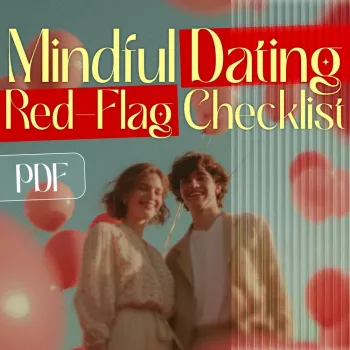
- Mindful Dating Red-Flag Checklist (printable) — a simple, repeatable way to track signals and protect pacing.
- The Ultimate Productivity Blueprint — helpful for keeping routines steady while dating (sleep, goals, boundaries around time).
- Stronger Together: Family Bonding Pack — a supportive option if you’re balancing dating with family time and want more intentional connection at home.
FAQ
What’s the difference between a red flag and a yellow flag in dating?
Red flags involve boundary violations, manipulation, intimidation, or repeated disrespect. Yellow flags are uncertainties or mild inconsistencies that call for clarification and observation. The key is pattern over time, not a single imperfect moment.
How many red flags are “enough” to stop seeing someone?
Any single major safety or consent violation is enough to step away. For smaller issues, repeated red flags usually signal a pattern, and slowing down or disengaging protects your emotional and physical safety.
Can a checklist make dating feel too guarded?
Used briefly, a checklist is a grounding tool—not a test. It can actually support openness by protecting pacing, consent, and clarity, so you can stay present without ignoring what your body and boundaries are telling you.










Leave a comment