Cat Body Language Cheat Sheet: Tails, Ears, Meows
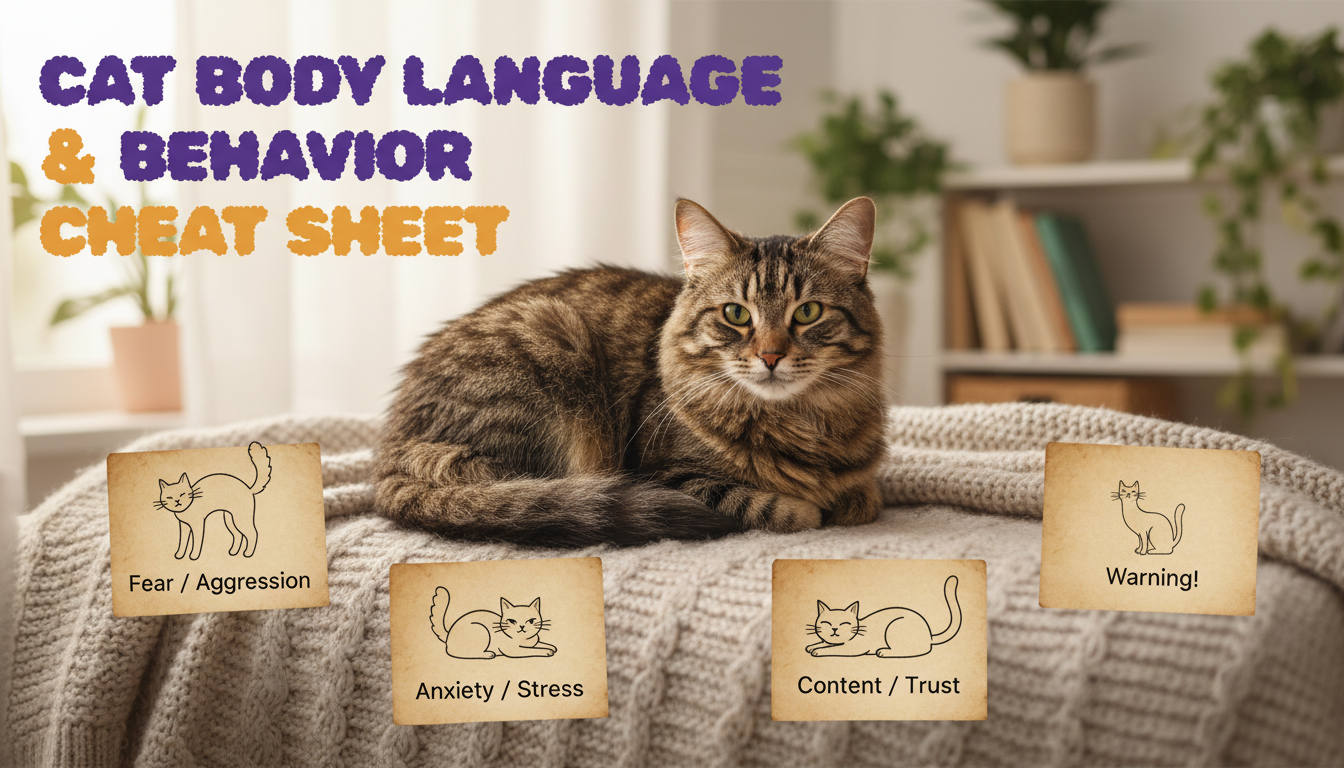
Cat Body Language & Behavior Cheat Sheet: A Practical Guide to Feline Signals, Postures, and Meows
Cats communicate constantly through posture, tail and ear positions, facial tension, vocalizations, and small shifts in movement. Learning to read these signals helps prevent bites and scratches, reduces stress, and strengthens trust—especially during petting, play, introductions, and vet visits. The key is to watch the whole cat, not a single “tell,” and respond early—before a swish becomes a swat.
How to Read a Cat’s Signals (Start with the Whole Picture)
Cat communication is clearest when you treat it like a pattern, not a single clue. A tail flick on its own can be nothing; a tail flick plus stiff shoulders and “airplane ears” is a message.
- Check context first: Where is your cat (window perch, food area, carrier)? What just happened (new person, vacuum, another pet walking by)?
- Look for clusters: Multiple signals together (ears + eyes + body tension + tail) are more reliable than any one sign.
- Notice change over time: Escalation often looks like stiffening, freezing, and fewer “options” besides fight or flight.
- Respect consent: When signals shift, pause petting and let your cat decide distance and duration.
- Use a consistent scan: Ears, eyes, whiskers, tail, body posture, then vocalizations.
Tail Positions and Movement: What the “Flag” Is Saying
The tail is a quick-read dashboard for arousal and comfort. Focus on both position and speed.
- Tail up (often with a slight hook at the tip): friendly greeting and comfort; common when approaching trusted people.
- Tail straight out: alert interest; your cat is engaged and evaluating.
- Tail low or tucked: uncertainty, fear, or discomfort; lower the “pressure” and give space.
- Puffed tail: high arousal (fear or agitation); avoid reaching in and create a calm exit route.
- Fast swishing or thumping: irritation or overstimulation; stop petting and offer a break.
- Slow tail wave: focused attention (often hunting or play); redirect to an appropriate toy.
Quick meanings for common body-language clusters
| What you see | Likely emotion | Best response |
|---|---|---|
| Tail up + soft eyes + relaxed body | Comfort / friendly | Offer calm greeting; gentle interaction |
| Tail thump + ears angled sideways + tense shoulders | Irritation / overstimulation | Pause touch; give space; switch to play at a distance |
| Puffed tail + sideways stance + wide eyes | Fear / defensive arousal | Do not corner; reduce noise; allow escape |
| Low tail + crouch + head turned away | Anxiety / uncertainty | Slow down; let the cat approach; use treats |
| Tail twitch at tip + still body + focused stare | High focus / hunting mode | Provide wand play; avoid hands as targets |
Ears, Eyes, and Whiskers: The Face Tells the Story
Facial signals are subtle but incredibly accurate—especially when paired with the tail and spine.
- Ears forward: interest and comfort; a great moment for training, treats, and play.
- Ears sideways (“airplane ears”): conflict or uncertainty; reduce intensity and increase distance.
- Ears flattened back: fear or agitation; avoid direct contact and remove triggers if possible.
- Slow blink: relaxation and social trust; respond with a slow blink back.
- Hard stare with a tense face: warning or high focus; don’t loom or force handling.
- Dilated pupils: can signal fear, excitement, or low light—confirm with posture and tail.
- Whiskers forward: interest/hunting; whiskers pulled back or flat: stress or defensiveness.
Postures and Distance: Relaxed, Unsure, Defensive, or Playful
A cat’s posture shows whether they feel safe and whether they want interaction. When in doubt, prioritize space and predictability.
- Relaxed: loose muscles, weight evenly distributed, normal grooming, comfortable stretching.
- Unsure: crouched body, slow movement, pausing, scanning; support with routine and gentle reinforcement.
- Defensive fear: crouch, head lowered, ears back, possible hissing; create distance and a clear retreat path.
- Offensive aggression: stiff legs, forward lean, direct stare; don’t challenge—redirect and separate safely.
- Play: bouncy movement, sideways hops, brief pounces; use toys to protect hands and reduce frustration.
- Belly exposed isn’t always “pet me”: many cats guard the belly and may grab or bite.
Meows, Purrs, and Other Sounds: Matching Voice to Body Language
Vocalizations make more sense when you match them to posture and facial tension. A soft meow from a relaxed cat is different from the same meow with pinned ears and a low tail.
- Meows are often aimed at humans: meaning depends on tone, repetition, and situation.
- Short meow: greeting or request; check food, door access, or attention needs.
- Repeated meows: urgency or learned behavior; respond consistently and reward calm requests.
- Yowl or long moan: distress, territorial tension, or mating-related vocalizing; assess environment and health.
- Purring: can mean comfort, but also self-soothing during stress or pain—confirm with posture and appetite.
- Hiss/growl/spit: clear request for distance; stop interaction and reduce triggers.
- Chirp/chatter at windows: excitement/frustration at prey; provide enrichment and interactive play.
Common Scenarios (and What to Do Next)
For deeper behavior guidance from trusted organizations, see the Cornell Feline Health Center and International Cat Care.
A Printable Reference for Daily Use
Helpful printables & guides
- Cat Body Language & Behavior Cheat Sheet (Printable Cat Communication Guide)
- Stronger Together: Family Bonding Pack
- The Ultimate Productivity Blueprint
FAQ
Why does a cat purr but still seem uncomfortable?
Purring can mean relaxation, but it can also be self-soothing during stress or discomfort. Check for tense posture, ears pinned back, a low/tucked tail, hiding, reduced appetite, or a sudden behavior change; if anything seems new or escalating, a vet check is a smart next step.
What does it mean when a cat shows its belly?
Belly-up often signals trust and comfort, but it’s not always an invitation to touch. Offer a hand nearby and pause; if your cat gets grabby or tense, switch to cheek/chin scratches or redirect to a toy instead.
How can overstimulation biting during petting be prevented?
Stop earlier by watching for warning signs like tail thumping, skin rippling, ears turning sideways, and freezing. Keep petting sessions short, do “consent tests” by pausing to see if your cat re-initiates, and use toys plus predictable routines to reduce frustration.










Leave a comment