Modern Etiquette Micro-Course: Texting, RSVPs & Social Media

Modern Etiquette Made Simple: A Micro-Course for Texting, Social Media, RSVPs, and Everyday Politeness
Etiquette today is less about memorizing rigid rules and more about helping people feel respected—online and off. A short, practical micro-course can turn awkward moments (late replies, confusing RSVPs, oversharing, tone-misreads) into clear, confident habits that fit real life. When expectations are clearer, relationships feel lighter: fewer guessy conversations, fewer “did I mess that up?” spirals, and more trust that people will show up (or gracefully bow out) in a way that works for everyone.
What “modern etiquette” actually solves
Modern etiquette is essentially a set of “polite defaults” for a world where communication is fast, constant, and often missing tone cues. It helps:
- Reduce friction in everyday interactions by making expectations clearer (timing, tone, boundaries).
- Prevent common misreads in digital communication where facial expression and voice are missing.
- Handle invitations, cancellations, and group plans without guilt, ghosting, or overexplaining.
- Build consistency: a reliable baseline that still leaves room for personal style and cultural differences.
Traditional etiquette resources still matter, but the modern twist is how quickly contexts change—work chats, group texts, DMs, and public comment threads. For a deeper foundation, the Emily Post Institute offers enduring principles that translate well into today’s platforms.
A quick-start toolkit: the three-part etiquette mindset
When social rules feel blurry, three habits keep things simple and kind:
- Clarity: Say the necessary thing plainly (who/what/when), especially in plans and logistics.
- Consideration: Anticipate the other person’s effort, time, privacy, and emotional load.
- Consistency: Choose reliable habits (reply windows, RSVP behavior, follow-through) that others can count on.
These three reduce overthinking because they’re repeatable. Instead of inventing a new response every time, you’re choosing from a small set of respectful patterns.
Texting etiquette that prevents 80% of awkwardness
Most texting tension comes from timing, tone, and uncertainty about what someone “meant.” A few simple moves eliminate the majority of misunderstandings:
- Reply timing: Aim for a predictable window. If you’re delayed, send a quick acknowledgment rather than silence.
- Tone: If a message could be read sharply, add context (a full sentence, a warm sign-off, or a clarifying line).
- Double-texting: Totally fine when it adds value (new info, a correction, a time-sensitive update) rather than pressure.
- Voice notes and calls: Ask before sending long audio. Call if the topic is sensitive, complex, or urgent.
- Group chats: Avoid side conflicts, limit rapid-fire messages, and summarize decisions so everyone stays included.
Common situations and polite message templates
| Situation | What to send |
|---|---|
| Running late | “Running about 10 minutes behind—sorry! On my way now.” |
| Can’t make it | “Thank you for inviting me—can’t make it this time. Hope it’s a great evening.” |
| Need more time to reply | “Got your message—thanks. I’ll check and get back to you by tomorrow.” |
| Follow-up after no reply | “Quick follow-up in case it got buried—does [time/day] still work?” |
| Clarifying tone | “To be clear, I’m not upset—just want to make sure we’re aligned.” |
Social media etiquette: boundaries, credit, and context
Social platforms blur the line between “public” and “personal.” Good manners online protect privacy, reduce drama, and keep relationships intact—especially when posts spread beyond the intended audience. (Research organizations like the Pew Research Center track how widely social media is used, which is exactly why boundaries matter.)
- Posting people: Ask before sharing identifiable photos, especially of kids, private homes, or sensitive events.
- Tagging: Tag only when it benefits the other person; avoid tagging for pressure, guilt, or exposure.
- Credit: Attribute creators and original sources; when in doubt, link back and avoid cropping watermarks.
- Commenting: Keep critique private and specific; avoid public correction unless safety or misinformation demands it.
- Direct messages: Lead with purpose and respect time—avoid “hey” with no context; keep requests concise.
When online interactions feel calmer and more respectful, it’s easier to maintain real connection—something the CDC emphasizes as a key part of overall well-being.
RSVPs and invitations: the politeness bottleneck
Invitations are where good intentions often collide with logistics. Hosts need numbers, timing, and clarity—not perfect explanations. A few simple habits make you the guest everyone can plan around:
Everyday politeness that still feels natural
What’s inside the Modern Etiquette Micro-Course
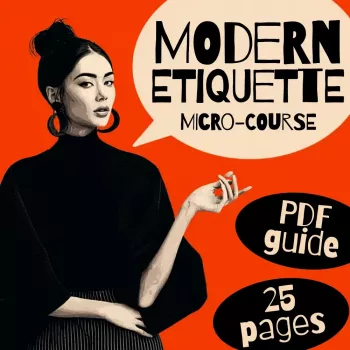
If having the “right words” at the right time would make life easier, a quick-reference guide can help. The Modern Etiquette Micro-Course | Printable Digital Etiquette Guide is designed for real situations, including:
For a broader “life systems” reset, pair etiquette habits with structure from The Ultimate Productivity Blueprint, especially if missed replies and last-minute changes are really a time-management issue in disguise. And if household connection is the goal, Stronger Together: Family Bonding Pack helps turn good intentions into consistent family routines.
Simple ways to use the guide week by week
FAQ
Is this guide suitable for teens and young adults?
Yes. It fits teens, college students, and new professionals because it focuses on current scenarios like texting tone, group chats, social media boundaries, and responding to invites clearly.
How do I handle a late RSVP or changing plans without sounding rude?
Reply as soon as possible with a clear yes or no, add a brief apology, and keep the explanation short. If your change affects costs or limited seating, offer a simple make-good (like covering your spot) without a long excuse.
Is the course printable and usable on a phone or tablet?
Yes. It’s designed as a digital guide that reads well on phones and tablets, and it can also be printed for quick, easy reference.











Leave a comment