Talk & Connect: 5-Minute Parent-Child Conversation Prompts

Talk & Connect: A Practical Parent-Child Communication Workbook for Everyday Closeness
Meaningful conversations don’t require perfect timing or long talks—they require simple tools that help parents and kids feel safe, heard, and understood. Talk & Connect is a guided workbook designed to turn everyday moments into stronger emotional connection, with prompts and activities that support calm communication, mutual respect, and lasting family bonds.
What Talk & Connect Helps Families Do
When life is busy (and emotions run hot), it’s easy for family communication to shrink into quick instructions, rushed logistics, or the classic “How was your day?” “Fine.” This workbook creates an easier path back to closeness—without forcing big talks or perfect emotional timing.
- Create a predictable, low-pressure way to talk (even when a child is quiet, shy, or easily overwhelmed).
- Replace “How was your day?” with questions that actually spark stories, feelings, and reflection.
- Build emotional vocabulary so kids can name what they feel instead of acting it out.
- Support positive parenting habits: listening first, validating feelings, setting boundaries without power struggles.
- Strengthen connection through short, repeatable routines that fit busy schedules.
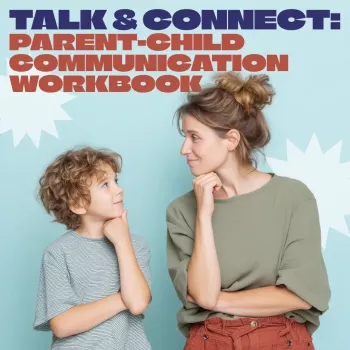
For families who want a structured guide, Talk & Connect: Parent-Child Communication Workbook offers ready-to-use prompts and reflection activities that work in real-life moments—before school, after practice, during bedtime, or whenever you can grab five minutes.
Who This Workbook Is Best For
Talk & Connect works well for many parenting styles because it focuses on emotional safety, respectful boundaries, and practical routines rather than “perfect” communication. It can be especially helpful for:
- Parents and caregivers who want more openness and fewer shutdowns, arguments, or one-word answers.
- Families navigating transitions such as a new school year, moving, separation/divorce, a new sibling, or changing routines.
- Kids who struggle with emotional regulation, frustration tolerance, or expressing needs respectfully.
- Parents who want a structured guide rather than improvising conversation prompts on the spot.
- Anyone looking for a gentle way to check in daily without turning it into an interrogation.
If you’re also building confidence and emotional skills in younger children, Confident Kids Bundle: Nurturing Emotional Strength pairs nicely with communication work by reinforcing feelings language, self-esteem, and simple emotional intelligence routines.
How to Use It Without Making It Feel Like Homework
The fastest way to make a connection tool backfire is to turn it into a performance. Kids share more when the “goal” is simply to be together and understand each other—not to extract information or solve everything immediately.
- Start with 5 minutes: choose one prompt, one reflection, and stop while it still feels easy.
- Use “side-by-side” moments (car rides, bedtime, snacks, walks) to reduce pressure and eye-contact intensity.
- Offer choices: “Want a fun question or a feelings question today?” to increase buy-in.
- Model first: answer the prompt yourself briefly so kids understand what “enough” looks like.
- Keep it consistent: a small daily habit typically builds more trust than occasional big talks.
- Avoid fixing immediately: reflect what was heard before offering advice (“That sounds disappointing.”).
Many parents find it helpful to think of communication like a bedtime routine: short, familiar steps that signal safety. Over time, kids learn that sharing won’t automatically lead to lectures, punishments, or pressure—so they share more.
Conversation Starters That Build Emotional Connection
Connection grows when questions feel specific and welcoming. The aim is to invite detail, help kids name emotions, and keep the tone balanced—light enough to be doable, deep enough to matter.
- Use open-ended questions that invite detail (“What was the best part?” becomes “What made it the best?”).
- Include body-based prompts to help kids link emotions to physical cues (tight chest, shaky hands, warm face).
- Balance light and deep: playful questions build comfort that makes deeper sharing possible later.
- Follow with a single gentle “tell me more” instead of stacking multiple questions.
- Close with reassurance and appreciation to reinforce safety (“Thanks for telling me—I’m glad I know.”).
| Prompt type | Best time to use | What it builds | Example starter |
|---|---|---|---|
| Playful connection | After school / transitions | Warmth and openness | “If today had a theme song, what would it be?” |
| Emotion naming | When moods shift or tension rises | Self-awareness and language | “What feeling showed up the strongest today?” |
| Problem-solving | After everyone is calm | Collaboration and responsibility | “What could make tomorrow 10% easier?” |
| Values and empathy | Dinner time / weekends | Perspective-taking | “What do you think someone else needed today?” |
| Repair and reassurance | After conflict | Trust and closeness | “What do you need from me right now?” |
Handling Tough Moments: Conflict, Shutdowns, and Big Feelings
For additional guidance grounded in child development, families may find these resources helpful: American Academy of Pediatrics (HealthyChildren.org), CDC Essentials for Parenting, and APA guidance on resilience.
Simple Weekly Routine for Stronger Bonds
When you want more “natural” talking time, add shared activities that lower pressure and increase warmth. Stronger Together: Family Bonding Pack supports this by pairing family activities with a simple checklist, making it easier to keep connection habits going during busy weeks.
Related Tools for Building a Connected Home
FAQ
What if a child only gives one-word answers?
Use low-pressure prompts and offer choices (fun question vs. feelings question), then try side-by-side conversations like car rides or snacks. Model your own short answer first, and follow up with just one gentle “tell me more” instead of stacking questions.
How often should the workbook be used to see a difference?
A realistic goal is about 5 minutes most days, plus one slightly longer weekly check-in. Consistency matters more than intensity—regular, calm conversations build safety and trust over time.
Is this better for younger kids or older kids?
It can work for both when prompts are adjusted by age: younger kids do well with playful, concrete questions and simple feeling words, while older kids and teens often respond better to reflective prompts that respect autonomy and invite collaboration.










Leave a comment